Driver monitoring and eco-driving: fewer risks, lower costs
An eco-driving score for the fleet, impact and braking alerts, licences kept up to date and accidents ranked by driver, within the framework set by the CNIL.
Hosted in the European Union · GDPR · Flotauto 2025 Innovation Award · free up to 50 vehicles, then €6 excl. VAT per vehicle per month
Driver monitoring in three facts
- An eco-driving score shown in the dashboard, next to the TCO and fleet availability.
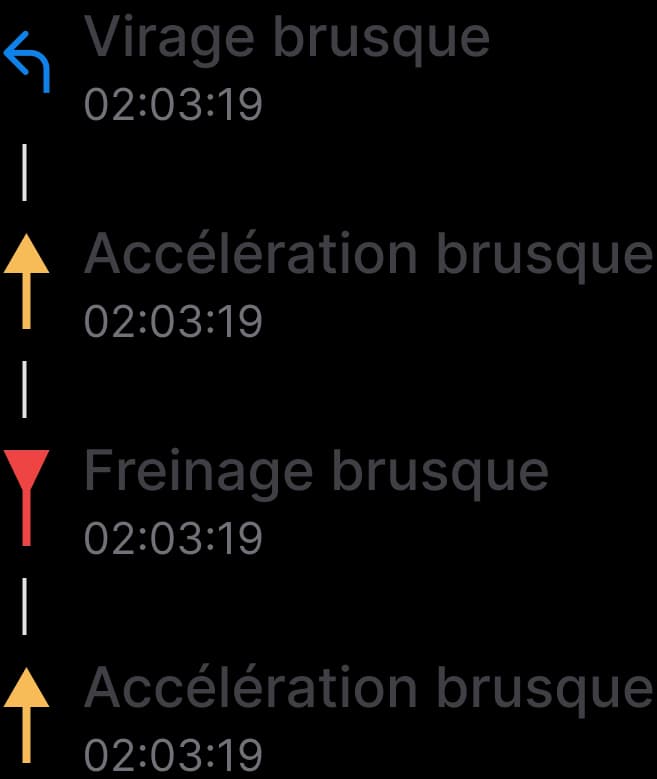
- Behaviour alerts reported by the vehicle: impact or collision, braking failure, brake pedal.
- One RFID badge per employee for picking up shared vehicles.
What a poorly monitored driver costs
- An expired or suspended licence that nobody knows about, and the company's liability engaged.
- Repeated accidents involving the same drivers, with no consolidated view to act on.
- Harsh driving that wears out brakes, tyres and fuel, with no warning before the invoice.
What you get with Dadycar
The principle: vehicle data and employee records meet in a single fleet management software, and every signal has an owner.
Eco-driving score
An eco-driving indicator calculated from telematics data and followed in the dashboard, per site and per period.
Trips per vehicle
The trip history of connected vehicles, by GPS/OBD device or by OEM vehicle, linked to the assigned driver.
Behaviour alerts
Impact or collision, braking failure, brake pedal: signals reported by the vehicle, with configurable severity, threshold and recipient.
Employee records and RFID badge
Role, site, account status and RFID badge per employee: the basis for assignments and car sharing.
Driving licences tracked
The licence is a driver document with an expiry date: an alert before the deadline, an up-to-date proof in the file.
Accidents ranked by driver
Every accident is reported with its liability and its status; the ranking of the most accident-prone drivers guides prevention.
How it works
- 1Create your employees and assign the vehicles. Records, RFID badges, sites and named or pool assignments from the employees and sites module.
- 2Connect the vehicles and set the alerts. Telematics reports trips and behaviour signals; you set thresholds and recipients.
- 3Follow the score and the accidents. Eco-driving score in the dashboard, ranking of accidents per driver in the claims and fines module.
Who it is for
- Fleet managers: licences, assignments and accidents kept in one place (see the role page).
- HR managers: licences tracked and ANTAI driver naming prepared from the assignment (see the role page).
- Healthcare and emergency services: vehicles shared between teams, picked up by badge (see the industry page).
Your drivers, your rules, in 30 minutes
A demo on your own fleet: together we set up the behaviour alerts and the licence tracking.
Your questions before getting started
- “What if my drivers refuse geolocation?” The CNIL framework requires prior information, specific purposes and deactivation outside working hours; Dadycar's time-based geofencing serves that distinction.
- “Do I need a device?” For the score and the behaviour alerts, yes, or a connected OEM vehicle. Licences, assignments and accidents work with no hardware.
- “Is this a disciplinary tool?” No: the signals serve prevention, servicing and safety, and the CNIL rules out speed-limit monitoring through geolocation.