Fleet geofencing: zones and hours for each site
Geographic zones and time slots that separate working time from the rest, to steer how vehicles are used without watching over people.
Hosted in the European Union · GDPR · Flotauto 2025 Innovation Award · free up to 50 vehicles, then €6 excl. VAT per vehicle per month
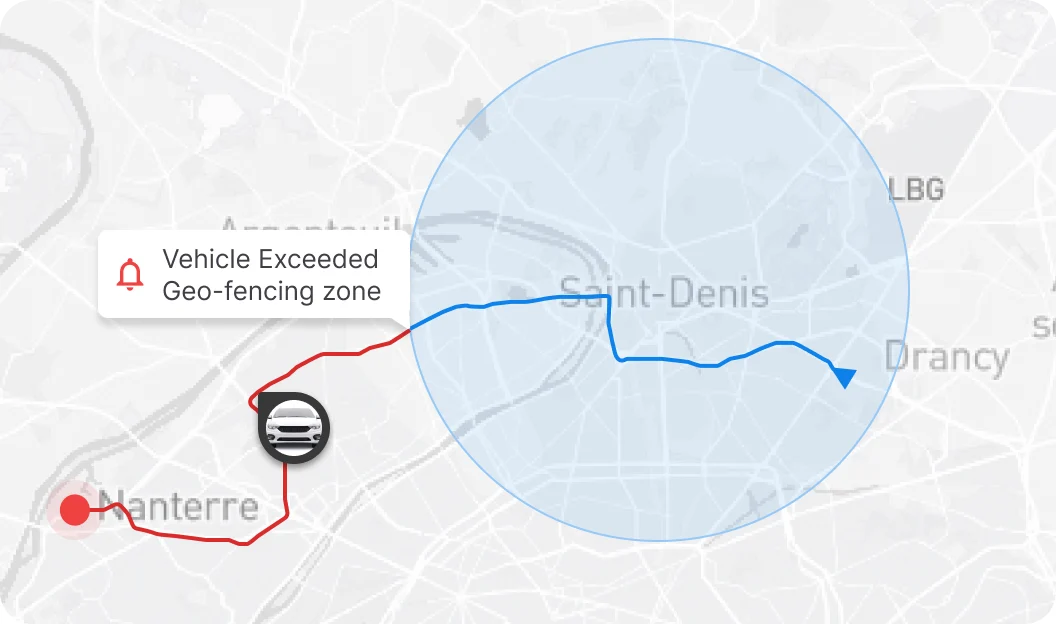
The Geofencing module in three facts
- Zones and hours combined: a rule covers a geographic perimeter and a time slot, not just a point on the map.
- Per site and per vehicle group: time zone, daily slots and public holidays are set at site and group level.
- Two sources of position: a GPS-OBD device or a connected OEM vehicle, with no installation in the second case.
What goes wrong without zone rules
- A vehicle seen on the map says nothing: with no time context, nobody knows whether the trip is business or private.
- Sites do not run to the same rhythm: branch hours, worked Saturdays, public holidays, different time zones.
- Permanent monitoring is forbidden and badly received: with no clear framework, the telematics project stalls at the works council.
What you get with Dadycar
Geofencing builds on the position data telematics already reports. You define the rules, the software flags the departures from them.
Geographic zones drawn on the map
Depots, sites, branches, service areas: every zone is outlined and attached to your sites.
Time slots per day
One slot per day of the week defines the working time expected for each site or vehicle group.
Time zones and public holidays
Every site carries its time zone and its public holiday calendar: the rules stay correct from one country to the next.
Vehicle groups
Site vans, service vehicles and company cars do not follow the same rules.
Business use told apart from private use
Combining a zone with a time slot is what qualifies a journey, rather than recording everything.
Idle-time-in-zone alerts
The idle-time-in-zone signal reports abnormally long stops inside a monitored perimeter.
How it works
- 1Connect the vehicles. A GPS-OBD device or a connected OEM vehicle: the position feeds the real-time map.
- 2Draw the zones and set the hours. Every site receives its time zone, its daily slots and its public holidays; every vehicle group, its own rules.
- 3Handle the departures from the rules. The signals arrive in the alerts, with severity, threshold and acknowledgement.
Who it is for
- Transport and logistics: checking depot visits and extended stops (see the industry page).
- Construction: knowing which machines and vans are on which site (see the industry page).
- Multi-site commercial fleets: different hours for each branch, one rule per site (see the industry page).
Your zones, drawn during the demo
Bring two or three of your sites: we set the zones, the time slots and the public holidays live.
Your questions before getting started
- “What if my drivers refuse to be located?” Time slots exist precisely for that: outside working time, collection has no reason to be active, and the employee must be able to switch it off.
- “Do I need a device?” A GPS-OBD device or a connected OEM vehicle: both report the position, the second with no equipment to fit.
- “How long does it take to start?” As soon as vehicles report their position and the sites are created, the first zones can be drawn.