Fleet reporting: your reports without extraction
Costs, mileage, fuel, charging, benefits in kind, sustainability: reports are built on the data already in the software, with up to -70 % of production time.
Hosted in the European Union · GDPR · Flotauto 2025 Innovation Award · free up to 50 vehicles, then €6 excl. VAT per vehicle per month
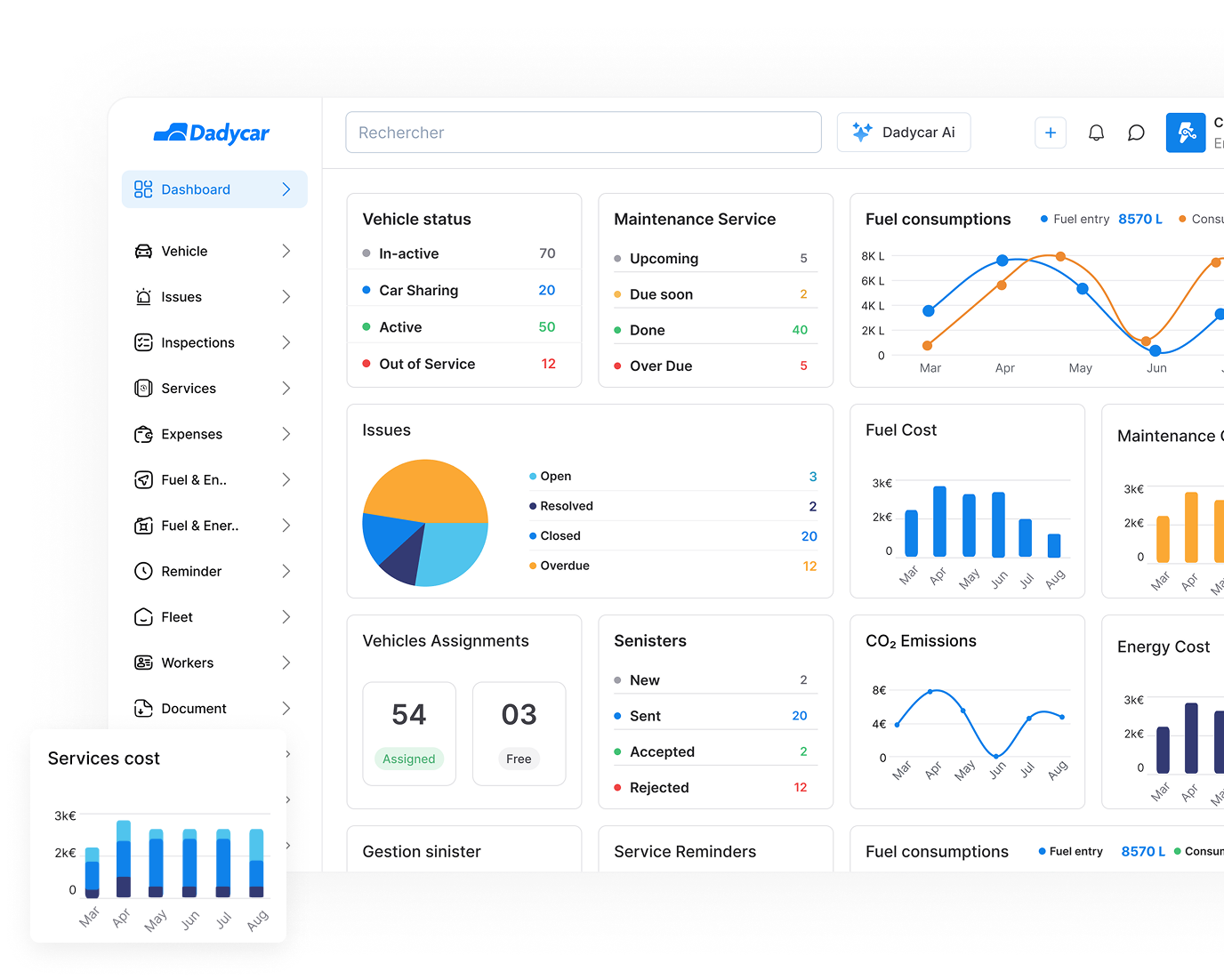
Dadycar reporting in three facts
- Up to -70 % of the time spent producing fleet reports.
- Three families of reports: Reports, Reports V2 in beta, and the benefit-in-kind report.
- Three exportable histories: fuel, charging, odometer readings.
The monthly report that eats a whole day
- Four sources to reconcile: fuel invoices, leases, servicing, mileage, each in its own format.
- A benefit in kind to declare for every company car, recalculated at each change of assignment.
- A management team that wants a figure, not a file: TCO per vehicle, share of electric vehicles, cost per entity.
What you get with Dadycar fleet reporting
The principle: every module records its data as it goes; the report is only a reading, never a re-entry.
Reports on the fleet and costs
The Reports module produces statements on the fleet, expenses and mileage; Reports V2, in beta, prepares finer report generation.
Benefit-in-kind report
The benefit-in-kind report brings together assigned vehicles and their data to prepare declarations, consistently with the public benefit-in-kind calculator.
Cost allocation per entity
The cost allocation tab of the dashboard breaks costs down per site or per entity, for multi-company groups and cost centres.
ESG sustainability
Energy mix, state of charge of electric vehicles, energy transition analyses: the raw material of CSR reporting, filtered by site and by period.
Fuel, charging and odometer histories
Every refuelling, every charge and every odometer reading is kept and can be consulted per vehicle.
Exports
Dashboard tabs and histories can be exported for accounting, management or a control spreadsheet.
How it works
- 1Let the data arrive. Fuel cards feed the histories; expenses are entered with invoice, VAT and supplier in the operational expenses module.
- 2Choose the scope. Site, period, entity: the same filters as the dashboard apply to reports.
- 3Read, export, declare. A cost report for management, a benefit-in-kind report for payroll, an ESG export for the CSR lead; the detail of electric vehicles is on the electric vehicle optimisation page.
Who it is for
- SME and mid-cap leaders: a readable cost report without tying up a person (see the role page).
- HR managers: the benefit-in-kind report ready for payroll at each change of assignment (see the role page).
- Purchasing managers: fuel histories per supplier for renegotiation (see the role page).
Your first report during the demo
A 30-minute demo on an extract of your fleet: together we produce a cost report and a benefit-in-kind report.
Your questions before getting started
- “Do I need a device?” No: cost reports, benefits in kind, cost allocation and fuel histories work with no hardware; telematics adds automatic odometer readings.
- “My data sits with my fuel supplier and my leasing company.” Fuel cards are attached to vehicles; contracts are entered at import.
- “What about Reports V2?” It is a beta version available in the application; the current Reports module remains available alongside it.